Quick answer: If you have healthy natural teeth, SnoreRx is the better first choice: it costs $59.99 against $99, you can adjust it 1 mm at a time, and in head-to-head research people were far more likely to keep wearing a jaw device than a tongue device. AVEOtsd is the better pick if you wear dentures, have extensive dental work or get jaw pain, because it holds your tongue instead of gripping your teeth, but only if you breathe easily through your nose.

SnoreRx and AVEOtsd both try to stop the tongue from falling back and narrowing your airway during sleep. They just grab a different part of you to do it. SnoreRx is a mandibular advancement device (MAD) that pushes your lower jaw forward; AVEOtsd is a tongue-stabilizing device (TSD) that holds the tongue tip forward with suction. Which one works for you depends mostly on your teeth, your jaw and your nose.
How we tested: We bought and tested SnoreRx ourselves (see our hands-on notes and video review below). We haven’t tested AVEOtsd; its details come from the maker’s specs, its FDA records and published research.
SnoreRx vs AVEOtsd: Side-by-Side
| Feature | SnoreRx | AVEOtsd |
|---|---|---|
| Type | Mandibular advancement device (two rigid trays) | Tongue-stabilizing device (one-piece silicone bulb) |
| What it holds | Your teeth, to move the lower jaw forward | The tip of your tongue, by suction |
| Maker | Apnea Sciences (California, USA) | Innovative Health Technologies (Dunedin, New Zealand) |
| Price | $59.99 (2 for $99.99) | $99 Medium; $119 Small/Large; $159 Medium twin pack |
| Fitting | Boil-and-bite impression (two attempts) | None; three sizes, Medium fits most people |
| Adjustment | 1 mm steps from a 1 mm factory setting | Only how much suction you create |
| Needs natural teeth | Yes | No |
| Mouth breathing | Open front allows some airflow | No; you must breathe through your nose |
| FDA status | 510(k)-cleared OTC for snoring in adults (K153200) | 510(k)-cleared OTC for snoring in adults (K231663, 2023) |
| Money-back terms | 30 nights, direct purchases from snorerx.com | 60 days for a single device, after contacting the maker; you pay to ship it to New Zealand |
| Best for | Most snorers with healthy teeth on a budget | Dentures, dental work, jaw pain |
Prices checked on each maker’s store in October 2026 and may change. Neither device is cleared to treat sleep apnea.
The Research That Compared These Two Device Types
Most “X vs Y” snoring comparisons rest on opinion. This one has an actual trial behind it, although not with SnoreRx itself. In 2009, researchers at the University of Sydney published a randomized crossover study in the journal Sleep that gave 27 people with diagnosed obstructive sleep apnea both an AVEOtsd and a jaw-advancing splint, four weeks each (Deane et al., 2009). 22 completed both arms.
| Result (Deane et al., 2009) | Jaw splint (MAD) | AVEOtsd (TSD) |
|---|---|---|
| Apnea-hypopnea index (baseline about 27/hour) | About 12/hour | About 13/hour |
| Complete or partial responders | 68% | 45% |
| Snoring eliminated (patient report) | 41% | 27% |
| Used every night for 6+ hours | 82% | 27% |
| Device removed involuntarily during the night | 9% | 86% |
| Preferred device at the end | 91% of patients preferred the jaw splint | |
Two caveats before you apply this to SnoreRx. First, the splint in the study was a custom, dentist-made device, not a boil-and-bite mouthpiece. Second, the participants had sleep apnea, not just snoring. Still, the pattern is useful: on paper the two approaches reduced breathing events by similar amounts, but in real life people kept wearing the jaw device and often gave up on the tongue device. The tongue device came off involuntarily during the night for most participants.
That is the main reason we suggest SnoreRx first for people who can wear a MAD. AVEOtsd earns its place when a jaw device isn’t an option at all.
SnoreRx: The Budget Adjustable Jaw Device
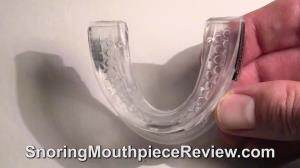
SnoreRx is two clear trays that lock together. You soften it in boiled water and bite into it to take an impression of your teeth, then move the lower tray forward one numbered millimeter at a time until your snoring stops. It ships at 1 mm; the instruction booklet says to wear each setting for three to five nights before moving forward and that most people settle between 3 and 5 mm.
- Why choose it over AVEOtsd: lower price, a fit that locks onto your teeth so it is unlikely to fall out, precise control over how far your jaw moves, and an open front that leaves some room for mouth breathing.
- Drawbacks: it is bulky, the trays are locked together so you can’t open your mouth much, you only get two fitting attempts, and early jaw or tooth soreness is the most common complaint. It is not for dentures, braces, loose teeth, gum disease or a history of TMJ disorder.
Read the full SnoreRx review for fitting tips and complaints, or see how to adjust a snoring mouthpiece.

If the locked-shut feel of a rigid two-tray device puts you off, the SnoreRx Plus adds a hinge and costs about the same as an AVEOtsd. We compare that pairing separately in SnoreRx Plus vs AVEOtsd.
AVEOtsd: The No-Teeth Tongue Device

The AVEOtsd is a soft, one-piece silicone device developed in New Zealand by dental sleep specialist Dr. Chris Robertson and sold since 1999. Its flanges rest on the outside of your lips, you put the tip of your tongue into the bulb, and suction holds it forward. There’s nothing to boil and nothing touches your teeth or moves your jaw.
- Why choose it over SnoreRx: it works with full dentures and missing teeth, puts no load on the jaw joint, and can’t shift your bite.
- Drawbacks: you have to breathe through your nose all night, it often comes off during sleep, drooling and a sore tongue tip are common at first, and at $99 it costs more. Returns mean contacting the company and shipping the device to New Zealand at your own cost.
There is no partner link for AVEOtsd. It is sold on the maker’s own store, and our AVEOtsd review covers sizing, the refund terms and where to buy.
Comfort: Jaw Soreness vs Tongue Soreness
Both devices have a break-in period; they just hurt in different places.
- SnoreRx: jaw, tooth or gum soreness in the morning, extra saliva, and a bite that feels “off” for a short time after you take it out. Starting at 1 mm and wearing it for a few hours while awake for the first days helps. See jaw pain from a snoring mouthpiece.
- AVEOtsd: a sore tongue tip, drooling or dry mouth, and lip irritation where the flanges sit. Using lighter suction and practicing while awake helps. Nothing presses on the teeth, so there’s no risk of bite changes.
If you already know your jaw can’t tolerate being held forward, that settles it in favor of AVEOtsd. If you are a mouth breather, it settles it the other way.
Cost Over a Year
SnoreRx is $59.99, and the two-pack ($99.99) costs about the same as a single AVEOtsd ($99). Neither maker publishes an official lifespan; boil-and-bite trays like SnoreRx typically need replacing after about a year of nightly use, sooner for heavy teeth grinders. For a first device, SnoreRx is the cheaper way to find out whether a mouthpiece helps your snoring, and its 30-night refund is simpler to use than shipping a device to New Zealand. Our guide to how long snoring mouthpieces last has replacement signs.
Our Hands-On Test: SnoreRx
We bought SnoreRx and tested it ourselves. The box held the mouthpiece, a storage case and an instruction booklet. The parts that touch your teeth are a soft, moldable lining over a firm frame, and after fitting we had deep, clear tooth impressions. You adjust it by pressing the sides and pulling the lower tray forward a step at a time. The front airway opening is about 3 mm: enough to breathe through, but too small to push your tongue through. Our tester recorded their snoring before using it, then wore SnoreRx for three nights, and the snoring-app recordings showed a significant drop in snoring each night. An overnight oxygen recording made while wearing it stayed above the report’s warning line. We found it comfortable as well as effective.
Full details, photos and screenshots are in our SnoreRx review.
What our testing adds to this comparison: SnoreRx is the device we have used: it molded cleanly, held our tester’s jaw forward comfortably and cut snoring over three nights. That supports choosing it if you have healthy natural teeth. AVEOtsd remains the option if you can’t wear a jaw device, but our notes on it come from the maker, the FDA and the research, not our own nights.
One tester’s nights are a real-world example, not a clinical trial. Snoring varies from person to person and night to night, and a snoring app or fingertip oxygen recording is not a sleep test.
Which Should You Choose?
- Choose SnoreRx if you have healthy natural teeth, no jaw joint problems, and want the cheapest adjustable option or sometimes breathe through your mouth.
- Choose AVEOtsd if you wear dentures, have few teeth or a lot of dental work, or a jaw device has already given you jaw pain, and you breathe comfortably through your nose.
- Consider Good Morning Snore Solution instead of AVEOtsd if you want a tongue device with a lower price and a 30-day money-back guarantee. See AVEOtsd vs Good Morning Snore Solution.
- See a doctor first if your snoring comes with pauses in breathing, gasping or daytime sleepiness. Those can be signs of obstructive sleep apnea, and neither device is a sleep apnea treatment. People under 18, or with loose teeth, gum disease, TMJ disorder or central sleep apnea, should check with a dentist or doctor before using either.
Still deciding between device types in general? Our TSD vs MAD guide walks through it.
Related Comparisons
- SnoreRx Plus vs AVEOtsd
- AVEOtsd vs Good Morning Snore Solution
- Good Morning Snore Solution vs SnoreRx
- SnoreRx vs SnoreRx Plus
- Best tongue stabilizing devices
Frequently Asked Questions
Is SnoreRx or AVEOtsd better for snoring?
For most people with healthy teeth, SnoreRx. It is cheaper, adjustable and stays on your teeth, and research comparing the two device types found people were much more willing to keep wearing a jaw device. AVEOtsd is better when you can’t wear a jaw device because of dentures, dental work or jaw pain.
Can I use SnoreRx with dentures?
No. SnoreRx needs natural teeth to grip, and the maker lists dentures as a reason not to use it. A tongue device such as AVEOtsd or Good Morning Snore Solution is the usual alternative. See best mouthpieces for denture wearers.
Do SnoreRx and AVEOtsd treat sleep apnea?
No. Both are FDA-cleared over the counter only as aids to reduce snoring in adults. If you might have sleep apnea, get a sleep test; a doctor can prescribe CPAP or a dentist-fitted oral appliance if needed.
Is AVEOtsd more comfortable than SnoreRx?
It is easier on the jaw and teeth, but not necessarily more comfortable overall. In the Deane trial, the tongue device caused frequent drooling and lip or tongue irritation and was often pulled out during sleep. Comfort depends on whether your jaw or your tongue is the more sensitive part.
Which is cheaper, SnoreRx or AVEOtsd?
SnoreRx: $59.99, or $99.99 for two. AVEOtsd is $99 for a Medium and $119 for other sizes on the official North American store.
Can mouth breathers use AVEOtsd?
Not really. The device seals your lips around the bulb, so you need to breathe through your nose. SnoreRx has an open front that allows some airflow. See the best mouthpiece for mouth breathers.