When you buy through our links, we may earn a commission. An affiliated entity may offer products or services. Learn more.
How SnoreRx Compares
| Model | Type | Score | Price | Best for | |
|---|---|---|---|---|---|
| SnoreRx (this review) | Adjustable MAD | 8.8 | $59.99 | Calibrated micro-adjustment | Check price |
| SnoreRx Plus | Adjustable MAD | 9.0 | $99.99 | Maximum adjustability | Check price |
| VitalSleep | Adjustable MAD | 8.8 | $119.95 | Best Warranty | Check price |
Prices are indicative; check the merchant for current pricing and discounts. Links marked “Check price” are affiliate links.
Our verdict: SnoreRx is one of the best-value adjustable mouthpieces you can buy without a prescription. You mold it to your teeth at home, then move your lower jaw forward in calibrated 1‑mm steps until the snoring stops — so you can use the smallest advancement that works instead of guessing. It is bulkier than hinge-style designs and it is not for people with TMJ problems, dentures or loose teeth. Want a hinged version you can take apart to clean? See SnoreRx Plus.
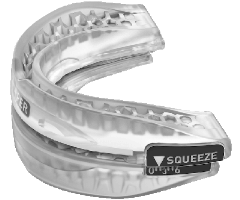
Short answer: SnoreRx is a boil-and-bite mandibular advancement device (MAD) from Apnea Sciences, a California company. It holds your lower jaw slightly forward so the tongue and soft tissue at the back of the throat are less likely to collapse and vibrate. Its selling point is the numbered, 1 mm adjustment scale, which most cheaper mouthpieces don't have. It is FDA-cleared as an aid for reducing snoring in adults — not as a sleep apnea treatment.
This review is based on the manufacturer's instruction booklet and website, the FDA 510(k) database, and patterns in verified buyer reviews. It covers how the fitting and adjustment actually work, what people complain about (and how to fix it), who should not use it, and how it compares with SnoreRx Plus and other mouthpieces.
Price: $59.99 (or buy 2 for $99.99)
Check Latest Price For SnoreRx
SnoreRx at a Glance
| Type | Two-tray mandibular advancement device (boil-and-bite) |
|---|---|
| Maker | Apnea Sciences Corporation, Aliso Viejo, California (made in the USA) |
| FDA status | 510(k)-cleared (product code LRK) as an aid for the reduction of snoring in adults 18+ — see K153200 and K170825. Not cleared to treat sleep apnea. |
| Fitting | Microwave-boiled water, 60 seconds; bite for 30 seconds; set in cool water for 5 minutes. Can be re-molded once (two fittings maximum). |
| Adjustment | 1 mm increments on a numbered scale, starting at the factory setting of 1 mm. Most users settle at 3–5 mm; third-party reviewers report the scale goes up to about 6 mm. |
| Sizes | One size; the boil-and-bite impression customizes it to your teeth |
| In the box | Mouthpiece, storage case, fitting handle, instruction booklet |
| Guarantee | 30-night money-back guarantee for new customers buying at snorerx.com (product price only; shipping not refunded) |
| Warranty | No separate warranty is advertised |
Pros and Cons
Pros
- Numbered 1 mm adjustment lets you find the least jaw advancement that stops your snoring, which is easier on your jaw than a fixed-position device.
- Custom boil-and-bite impression grips the teeth well, so it is less likely to fall out during the night than generic one-size trays.
- Open front leaves room for some airflow through the mouth.
- FDA-cleared, made in the USA, and inexpensive for an adjustable MAD — and the two-pack brings the per-unit cost down further.
- 30-night refund window if it doesn't work for you.
Cons
- Bulky: it's a rigid two-tray design, and some people find their lips don't close comfortably around it.
- No hinge — you can't open your mouth much while wearing it (SnoreRx Plus adds a hinge).
- Only two fitting attempts; a bad impression is the most common reason it doesn't work.
- Not suitable for dentures, braces, loose teeth, gum disease or a history of TMJ disorder.
- The refund only applies to purchases made directly from the manufacturer.
Video Review
A video review of SnoreRx for SnoringMouthpieceReview.com:
How SnoreRx Works
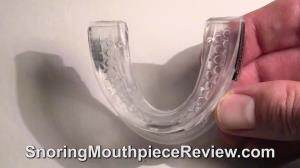
Most snoring happens when the muscles of the tongue and throat relax during sleep and the airway narrows; the air squeezing past makes the soft palate and surrounding tissue vibrate. Because the tongue is attached to the lower jaw, moving the jaw forward a few millimeters pulls the tongue base forward too and widens the space behind it. That is the principle behind every MAD, and it is the same idea dentists use with custom oral appliances (see how snoring mouthpieces work).
SnoreRx has two trays — one for the upper teeth, one for the lower — that lock together at the front. The upper tray carries the word “SQUEEZE” on both sides. To adjust it, you squeeze those two spots, slide the lower tray forward or back to the next number, and release; it clicks into place. The setting is shown on both sides, and the manufacturer tells you to make sure the two sides match.
The manufacturer's FDA filing describes it the same way: an intraoral device made of two trays, molded to the teeth by the boil-and-bite method, that repositions the jaw forward to increase the space in the throat. The trays use a material the company calls “Thermal Matrix,” which softens in near-boiling water and holds the shape of your teeth once it cools.
How to Fit SnoreRx (Boil-and-Bite)
The fitting is the step that decides whether SnoreRx works for you, and the booklet is specific about it. The steps below summarize the official instructions; watch the manufacturer's fitting video before you start, because you only get two attempts.
- Clip the mouthpiece onto the fitting handle. Don't change the factory setting before you fit it.
- Bring a mug of water to a full boil in the microwave. The manufacturer warns against a stovetop pan because the hot metal can damage the material.
- Hold the handle and submerge the device for exactly 60 seconds.
- Lift it out and dip it in a bowl of cool tap water for 1–2 seconds to remove hot water.
- Center your teeth in both the top and bottom trays and bite down firmly for 30 seconds.
- Put it in cool water for 5 minutes to set the impression.
- Check for clear, well-defined tooth marks. If they're shallow or off-center, repeat the process (a second fitting is allowed; a third is not recommended).
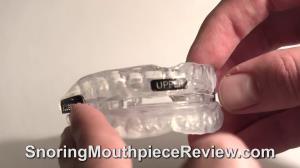
Tips that cut down on fitting failures: practice the bite without heating first so you know where your teeth go; keep your lower jaw relaxed rather than pushing it forward while you bite (the device does the advancing later); and don't chew or move while the material is soft. More general advice is in our guide to fitting an anti-snoring mouthpiece.
Adjusting SnoreRx: Start Low, Go Slow
SnoreRx ships at 1 mm of advancement. The booklet says to wear each setting for at least three to five nights before moving forward another millimeter, and that most people end up between 3 and 5 mm. The product page suggests a slightly faster pace (every 2–3 nights). Either way, the point is the same: move one step at a time and stop at the first setting that controls your snoring, because every extra millimeter adds strain on the jaw joint.
A practical way to judge progress is to record yourself with a snoring app (such as SnoreLab) for a few nights at each setting and ask your bed partner. If you reach the upper settings and are still snoring heavily, that's a reason to talk to a doctor rather than to keep pushing the jaw forward — persistent loud snoring can be a sign of sleep apnea. Step-by-step help is in how to adjust a snoring mouthpiece.
What Buyers Report
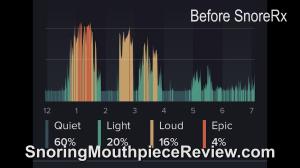
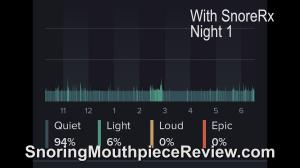
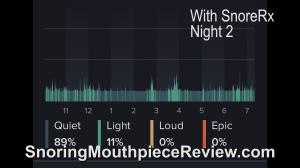
SnoreLab app recordings: the night before using SnoreRx, then the first and second nights wearing it.
Across retailer and review-site feedback, the pattern is consistent. People whose snoring comes from the tongue and jaw falling back — often back sleepers who snore loudly with their mouth closed — tend to report a clear drop in snoring within the first week or two, usually after moving up a couple of settings. The negative reviews mostly fall into three groups: the device felt too big to sleep with, jaw or tooth soreness didn't settle, or the impression never fit properly. Those are covered in the next section.
Two things worth knowing before you buy. First, results vary a lot with the cause of the snoring: if your snoring is mainly nasal (congestion, a deviated septum), a jaw-advancing mouthpiece may only help partly; the manufacturer itself suggests side sleeping helps, and some people combine a MAD with nasal strips (see mouthpieces vs nasal strips). Second, a snoring app is useful for tracking your own progress, but it isn't a sleep test.
Common SnoreRx Complaints (and What to Do About Them)
“SnoreRx complaints” is a common search, so here are the issues that come up most, why they happen, and what you can do. We cover them in more depth in our SnoreRx complaints guide.
Jaw soreness in the morning
This is the most common complaint with any MAD. The booklet lists soreness of the jaw joint, teeth and gums as known effects. It usually fades within the first week or two. What helps: start at the 1 mm factory setting, wear it for 1–3 hours while awake for the first 2–3 days (the manufacturer's own advice), and move back one setting if your jaw is sore after you advance. Pain that lasts all day or doesn't improve after a couple of weeks is a reason to stop and see a dentist. See jaw pain from a snoring mouthpiece.
Drooling or dry mouth
Extra saliva in the first nights is your mouth reacting to a foreign object, and it's listed in the official warnings. It usually settles within days. Dry mouth can happen if your lips don't seal around the device and you breathe through your mouth; staying hydrated and keeping the device clean help.
Feeling bulky, or it falls out
SnoreRx is a rigid two-tray design, and some users find it hard to close their lips over it. If it falls out at night, the impression is usually too shallow. The manufacturer's guarantee page says the same thing: poor impressions are a frequent reason for returns, and clear, deep tooth marks are the sign of a good fit. Re-fit it once, following the timing exactly.
Bite feels “off” in the morning
Many MAD users notice their back teeth don't meet normally for a short while after taking the device out. That usually goes away within minutes to an hour; gently chewing or using a morning repositioning routine your dentist suggests can speed it up. The booklet warns that MADs can cause tooth movement or changes in your bite over time, so tell your dentist you use one and stop if your bite doesn't return to normal. More in are snoring mouthpieces bad for teeth?
The fitting failed
The typical causes are using a stovetop pan instead of a microwave mug, leaving it in hot water longer or shorter than 60 seconds, or not letting it set for the full five minutes. You get a second try. If both attempts fail, contact support within your 30 nights (1-800-546-1984) — the company asks you to call about fit and adjustment before the trial ends.
Who Should Not Use SnoreRx
The instruction booklet lists these contraindications. Don't use SnoreRx if you:
- Are under 18
- Have central sleep apnea or a respiratory disorder
- Have a history of TMD (temporomandibular joint disorder)
- Have loose teeth, abscesses, severe gum disease or advanced periodontal disease
- Wear dentures, braces or other dental appliances
- Have implants, crowns or caps — unless your dentist approves
Denture wearers should look at a tongue-based device instead (see best snoring mouthpiece for denture wearers). For a fuller checklist, read who should not use a snoring mouthpiece.
Is SnoreRx Safe? Sleep Apnea and Medical Notes
SnoreRx is cleared for snoring only. The manufacturer's own caution is worth repeating: snoring can be a sign of obstructive sleep apnea, which is linked to heart and vascular risk and drowsy-driving accidents, and SnoreRx is not a treatment for it. If you stop breathing or gasp in your sleep, wake up unrefreshed, or are very sleepy during the day, get evaluated by a doctor before relying on a mouthpiece. If you're diagnosed, a sleep physician or dentist can discuss oral appliances made for apnea alongside CPAP (see can snoring mouthpieces treat sleep apnea? and sleep apnea mouthpiece vs CPAP).
The booklet also recommends telling your dentist you use the device and having them check your teeth, gums and jaw at your regular visits. That's sensible advice for any over-the-counter MAD.
Cleaning and Lifespan
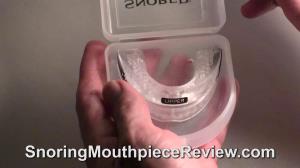
The official care instructions are simple: brush your teeth before putting it in; after each use, brush the device gently with a toothbrush and toothpaste; let it air-dry; and keep it in the case. Avoid ammonia, bleach, alcohol-based mouthwash and denture-tablet soaks, which can damage the material. Our cleaning guide has more detail.
SnoreRx doesn't publish an official lifespan. Independent reviewers commonly cite roughly a year to 18 months, and heavy teeth grinders wear through boil-and-bite trays faster. Replace it when you see cracks, the impressions have worn smooth, the adjustment won't hold, or it no longer stays in place. See how long snoring mouthpieces last. The two-pack ($99.99) is the cheaper way to have a spare for travel or replacement.
SnoreRx vs SnoreRx Plus

Both use the same boil-and-bite fitting and the same 1 mm adjustment system, and both carry the same 30-night guarantee. According to the manufacturer, the Plus adds two things:
- A hinge, so your jaw can open and close vertically during the night instead of being held shut.
- A three-piece design that comes apart (upper, middle and lower trays), which makes it easier to clean every surface.
Pick the original if you want the lowest price and don't mind a fixed, closed-mouth feel. Pick the Plus ($99.99) if you feel claustrophobic in rigid trays, want to be able to open your mouth slightly, or care about easier cleaning. Neither is suitable for denture wearers. Full comparison: SnoreRx vs SnoreRx Plus.
How SnoreRx Compares With Other Mouthpieces
- VitalSleep — also boil-and-bite and adjustable, but adjusted with a small hex key rather than a squeeze-and-slide scale; comes in two sizes. See SnoreRx vs VitalSleep.
- ZQuiet — a thin, flexible “living hinge” design with no molding step; easier to get used to, but it isn't finely adjustable. See ZQuiet vs SnoreRx.
- Zyppah — combines jaw advancement with an elastic tongue band. See SnoreRx vs Zyppah.
- Tongue-stabilizing devices such as Good Morning Snore Solution hold the tongue rather than the jaw, so they suit denture wearers and people with jaw problems. See Good Morning Snore Solution vs SnoreRx and TSD vs MAD.
- Also compared: SnoreRx vs AVEOtsd, SnoreRx vs SnoreMender, PureSleep vs SnoreRx, and ApneaRx vs SnoreRx. For other options, see SleepTight.
Where to Buy SnoreRx
The 30-night money-back guarantee only covers new customers who buy from snorerx.com, and refunds cover the product price but not shipping. The manufacturer lists customer support at 1-800-546-1984 and support@snorerx.com. Some sleep-app stores (SnoreLab, SleepScore) have also carried it, and secondhand or third-party listings turn up on marketplaces, but those don't come with the manufacturer's guarantee — and a used boil-and-bite device can't be re-molded properly. Details in where to buy SnoreRx.
Bottom Line
SnoreRx does what an adjustable MAD should do, at a lower price than most: it molds to your teeth, it adjusts in small, repeatable steps, and it's FDA-cleared for snoring. It's the right first try for an adult with healthy teeth whose snoring comes from the jaw and tongue falling back. Skip it if you have dentures, loose teeth, gum disease or TMJ problems, and get checked for sleep apnea if your snoring comes with gasping, pauses in breathing or daytime sleepiness. Take the fitting seriously and advance slowly — most of the complaints come from rushing those two steps.
Check Latest Price For SnoreRx
FAQ
Is SnoreRx the same as “Snore Rx”?
Yes. “Snore Rx” is just the spaced spelling. There's one SnoreRx mouthpiece, plus the hinged SnoreRx Plus, both made by Apnea Sciences.
Is SnoreRx sold on Amazon?
When we checked, we couldn't confirm a listing sold by the manufacturer on Amazon, and the 30-night guarantee only applies to purchases made at snorerx.com. If you buy anywhere else, check who the seller is and make sure the device is new and sealed, since a used boil-and-bite tray won't mold properly. See where to buy SnoreRx.
What are the most common SnoreRx complaints?
Morning jaw soreness, extra saliva in the first nights, the device feeling bulky, a temporarily “off” bite in the morning, and failed fittings. Most improve by starting at 1 mm, advancing slowly and redoing a shallow impression. Persistent pain or a lasting bite change means stop and see a dentist. More in our SnoreRx complaints guide.
Does SnoreRx work for sleep apnea?
SnoreRx is FDA-cleared only as an aid to reduce snoring, and the manufacturer states it is not a treatment for sleep apnea. If you suspect apnea, get a diagnosis first; a doctor can tell you whether an oral appliance designed for apnea is appropriate.
How long does SnoreRx last?
The manufacturer doesn't state a lifespan. Independent reviewers generally cite around a year to 18 months with daily use and proper cleaning; grinding your teeth shortens that. Replace it when it cracks, loosens or stops holding its setting.
What's the difference between SnoreRx and ApneaRx?
Both come from Apnea Sciences. SnoreRx is the over-the-counter snoring device; the ApneaRx line is the company's apnea-oriented appliance, and the newer ApneaRx Pro's FDA clearance covers mild to moderate obstructive sleep apnea and/or snoring — so it should be used with a diagnosis and a clinician involved. See ApneaRx vs SnoreRx.