When you buy through our links, we may earn a commission. An affiliated entity may offer products or services. Learn more.
How ZQuiet Compares
| Model | Type | Score | Price | Best for | |
|---|---|---|---|---|---|
| ZQuiet (this review) | Living-hinge MAD | 8.5 | $59.95 | Comfort & mouth-breathers | Check price |
| VitalSleep | Adjustable MAD | 8.8 | $119.95 | Best warranty | Check price |
| SnoreRx Plus | Adjustable MAD | 9.0 | $99.99 | Maximum adjustability | Check price |
Prices are indicative; check the merchant for current pricing and discounts. Links marked “Check price” are affiliate links.
Our verdict: ZQuiet is the easiest mandibular advancement device to start with — ready to wear out of the box, with a flexible “living hinge” that lets your mouth open and your jaw move while you sleep. It suits first-time users and people who hate bulky trays. Its trade-off is precision: there are only two fixed advancement sizes and no custom molding, so heavier snorers who need fine-tuning are usually better served by an adjustable device such as SnoreRx Plus or VitalSleep.
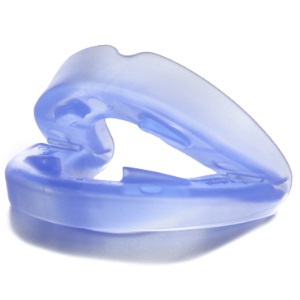
Short answer: ZQuiet is an FDA-cleared, over-the-counter mandibular advancement device (MAD) that holds your lower jaw slightly forward to keep the airway behind your tongue from narrowing. It needs no boiling or molding, comes as a two-size starter pack (a gentle 2 mm and a stronger 6 mm advancement), and is backed by a 60-night guarantee. Many buyers find it one of the most comfortable MADs to wear (though our own tester got sore bottom front teeth; see our hands-on test), but it is not adjustable beyond those two sizes, and it is a snoring aid — not a treatment for sleep apnea.
Price: $59.95 (2-Size Starter Pack: two mouthpieces in two sizes)
How we reviewed it: we bought ZQuiet and tested it ourselves (see our hands-on test and video review), and combined that with ZQuiet’s own product documentation and FAQ, its FDA 510(k) clearance records, independent reviews, and patterns in verified-buyer feedback. Specs and policies were checked in October 2026.
ZQuiet at a Glance
| Device type | Mandibular advancement device (lower jaw forward), ready-to-wear |
|---|---|
| Fitting | None — no boil-and-bite; edges can be trimmed if the fit is long |
| Advancement | Two fixed sizes: about +2 mm (Size 1) and +6 mm (Size 2); not adjustable |
| Hinge | Flexible “living hinge” — mouth can open, jaw can move side to side |
| Material | Soft thermoplastic compound; free of BPA, latex and silicone (per manufacturer); made in the USA |
| FDA status | 510(k) cleared to reduce snoring in adults (product code LRK; maker Sleeping Well, LLC) |
| Guarantee | 60-night “Better Sleep Guarantee” with free return shipping; original shipping charges not refunded |
| Typical lifespan | Replace every 4–6 months (about every 3 months if you clench or grind) |
| Where to buy | ZQuiet.com, the official ZQuiet store on Amazon, some dentists and physicians |
Our Hands-On Test (Video Review)
We bought ZQuiet and tested it ourselves; the video below covers the box, the device, our results and cleaning.
- In the box: a case holding two mouthpieces in different sizes, plus three booklets: Instructions for Use and Care, 25 Tips for a Better Night’s Sleep and 25 Ways to Enhance Intimacy in Your Relationship.
- Material: soft, flexible, latex-free and BPA-free thermoplastic. One size holds the jaw less far forward than the other; the stronger one can be more effective, and you can use whichever you find comfortable.
- Airway opening: about 3 mm when fully closed, though the hinge usually keeps the mouth open wider than that.
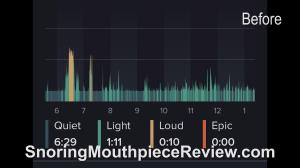
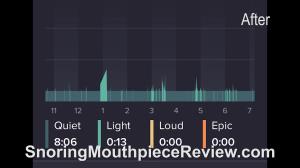
- Results: over a few nights of wearing it, our tester’s snoring-app recordings showed snoring was quieter (screenshots further down), and pulse-oximeter recordings were taken while wearing it.
- Comfort: our tester found ZQuiet easy to use but woke every morning with discomfort between the bottom front teeth and lip, with both sizes.
- Cleaning: very warm water with a little mild soap or detergent, a toothbrush scrub of every surface for 1–2 minutes, a thorough rinse, then shake off and pat dry with a soft towel.
- Verdict from our test: easy to use and it can reduce snoring, but it may cause discomfort because it isn’t custom-fitted to your teeth.
One tester’s nights are a real-world example, not a clinical trial. Snoring varies from person to person and night to night, and a snoring app or fingertip oxygen recording is not a sleep test.
How ZQuiet Works
Most snoring comes from soft tissue at the back of the throat vibrating as air squeezes past. When you fall asleep, the muscles that hold the jaw and tongue in place relax, the lower jaw drops back, and the tongue base drifts toward the throat. A mandibular advancement device counters that by holding the lower jaw a few millimeters forward. Because the tongue is attached to the jaw, it comes forward too, which widens the airway and reduces the vibration. (For the full mechanism, see how snoring mouthpieces work.)
ZQuiet does this with two thin, soft trays — one for the upper teeth, one for the lower — joined by a flexible strip of the same material at the back. That strip is the “living hinge.” It sets how far forward your lower jaw sits, but unlike rigid one-piece mouthguards, it lets your mouth open and close and lets your jaw shift slightly side to side. That freedom is the main reason people describe ZQuiet as less claustrophobic than bulkier devices, and it is why ZQuiet is a reasonable choice for people who sometimes breathe through their mouth or who want to sip water without taking the device out.

The trade-off is that the hinge gives less positive control of the jaw than a rigid or locked design. If your snoring needs a larger or very precise amount of advancement, a device you can dial in millimeter by millimeter tends to do better.
Sizes: Size 1 (2 mm) vs Size 2 (6 mm)
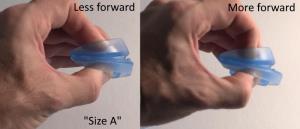
The standard ZQuiet “2-Size Starter Pack” contains two mouthpieces. They are the same shape; what differs is how far forward they hold your lower jaw:
- Size 1 (about +2 mm): a gentle advancement. ZQuiet recommends starting here because it is the easiest on the jaw muscles and joints while you get used to sleeping with something in your mouth.
- Size 2 (about +6 mm): a stronger advancement for snoring that continues with Size 1. Expect more morning jaw tightness for the first week or so.
There is nothing in between. Many adjustable MADs let you move in 1 mm steps, which matters because the “right” amount of advancement is the smallest one that stops your snoring. If Size 1 is not enough and Size 2 is too much, ZQuiet has no middle setting — that is the most common reason people move on to an adjustable device.
ZQuiet also sells a Firm version with a stronger hinge for people who clench or grind and wear through the standard hinge quickly, and a newer ZQuiet Advance, a separate moldable design with four advancement settings via interchangeable straps. This review covers the original ready-to-wear ZQuiet (sold as the Comfort starter pack), which is what most people searching “ZQuiet review” are buying.
Fitting and First Nights
There is no boil-and-bite step. You take Size 1 out of the case, rinse it, and put it in at bedtime: upper teeth into the top tray, lower teeth into the bottom tray. Practical tips drawn from the manufacturer’s instructions and common buyer feedback:
- Give Size 1 at least a week. Mild jaw or tooth tenderness in the morning is normal at first and usually fades within a few minutes of taking the device out. If it is bad, take a night or two off rather than pushing through.
- Only move to Size 2 if you are still snoring after your jaw has adapted to Size 1. Record your snoring (a free app such as SnoreLab works) so you are comparing real numbers, not impressions.
- If it feels too long or rubs the back of your mouth, ZQuiet allows you to trim the edges slightly with small scissors and smooth them with an emery board. Per the guarantee terms, trimming doesn’t void the guarantee.
- Front-teeth fit matters. ZQuiet says the device works best with fairly straight front teeth (it can also be worn over clear aligners such as Invisalign). Very crowded or uneven front teeth can make the universal trays sit poorly.
For more on getting used to any mouthpiece, see how to fit an anti-snoring mouthpiece and jaw pain from a snoring mouthpiece.
Does ZQuiet Actually Work?
The mechanism is well established: guidelines from the American Academy of Sleep Medicine and the American Academy of Dental Sleep Medicine support oral appliances as a treatment for primary snoring in adults. What varies is how well a particular over-the-counter device works for a particular person, and ZQuiet has not published a large independent trial of its own device. So the honest answer is: it works best for people whose snoring is caused mostly by the jaw and tongue falling back, who respond to a small-to-moderate advancement, and who will actually keep it in all night — which is where ZQuiet’s comfort is a genuine advantage.
It is less likely to be enough if your snoring is mainly nasal (congestion, a deviated septum), if you need more advancement than Size 2 provides, or if your snoring is a sign of obstructive sleep apnea.
Before and after: SnoreLab recordings
The two screenshots below are SnoreLab recordings from our own test: a night without a mouthpiece and a night wearing ZQuiet. A pair of nights is an anecdote, not a study, but recording before-and-after nights like this is the best way to judge whether ZQuiet works for you within the 60-night guarantee window.
Pros and Cons
Pros
- Ready to wear the first night — no boiling, molding or mess.
- Thin, soft and low-profile; the living hinge lets you open your mouth, talk briefly, and sip water.
- Two advancement levels in one pack, so you can start gently.
- FDA 510(k) cleared for reducing snoring; made in the USA; free of BPA, latex and silicone per the maker.
- 60-night guarantee, and the device can be trimmed without voiding it.
- Sold directly and through an official Amazon store, which makes returns and authenticity straightforward.
Cons
- Not adjustable — only two fixed positions (about 2 mm and 6 mm), with a big jump between them.
- No custom molding; retention depends on how well the universal trays fit your teeth.
- Soft material and a thin hinge wear out; the maker suggests replacement every 4–6 months (about 3 months for grinders), so the yearly cost is higher than the sticker price suggests.
- Like every MAD: possible jaw soreness, tooth tenderness and extra saliva or dry mouth while you adapt.
- Not suitable for people with full dentures, and not a substitute for sleep apnea diagnosis and treatment.
Common ZQuiet Complaints (and What Helps)
Searches for ZQuiet complaints mostly turn up the same handful of issues. Here they are, with the usual fixes:
- Sore jaw or teeth in the morning. This is the most common complaint with any MAD. Start (or go back) to Size 1, take a night off if needed, and gently move your jaw back into its normal bite for a few minutes after removing the device. Pain that persists, or any change in how your back teeth meet, is a reason to stop and talk to a dentist. ZQuiet’s FAQ says to stop using it and contact them if tooth pain doesn’t go away.
- Drooling or dry mouth. Common during the first week or two as your mouth adapts; it usually settles.
- It falls out or feels loose. The non-molded trays don’t grip every set of teeth equally. Crowded or uneven front teeth make this worse. If trimming doesn’t help, a boil-and-bite device that molds to your teeth is usually the better fit.
- It worked at first, then stopped. Usually wear: the hinge and trays soften and stretch over months, especially with clenching. Replace it, or try the Firm version.
- Size 1 isn’t enough, Size 2 is too much. A real limitation of the two-size system; an adjustable MAD with 1 mm steps solves it.
- Refund surprises. The guarantee refunds the product price and return shipping is free, but the shipping you paid on the original order isn’t refunded. Request your return authorization inside the 60-night window and check the current terms at checkout.
Who ZQuiet Is For — and Who Should Skip It
Good fit: first-time mouthpiece users, light-to-moderate snorers, people who found other mouthguards too bulky or claustrophobic, people who sometimes breathe through their mouth, and anyone who doesn’t want to deal with boil-and-bite fitting.
Skip it or talk to a dentist first if you:
- wear full dentures (a MAD needs natural teeth to hold on to — see mouthpieces for denture wearers);
- have loose teeth, active gum disease, a recent dental procedure, or existing TMJ pain;
- have braces (clear aligners are generally fine per ZQuiet);
- are under 18;
- have signs of sleep apnea: gasping or choking at night, pauses in breathing noticed by a partner, heavy daytime sleepiness, morning headaches, or high blood pressure. Get evaluated by a doctor first — a snoring mouthpiece can quiet the noise while the underlying problem continues. See can snoring mouthpieces treat sleep apnea? and who should not use a snoring mouthpiece.
Cleaning, Care and Lifespan
- Clean it every morning with a soft toothbrush and mild soap and water, or with ZQuiet Clean. Avoid bleach, alcohol, ammonia and alcohol-based mouthwash, which can degrade the material; independent reviewers also advise against abrasive toothpaste.
- Let it air-dry and store it flat in its case — ZQuiet says storing it flat helps the hinge keep its strength.
- Expect to replace it every 4–6 months with nightly use, or about every 3 months if you clench or grind. ZQuiet offers discounted subscription refills.
More detail: how to clean a snoring mouthpiece and how long snoring mouthpieces last.
See current pricing and refill options on the official ZQuiet website.
ZQuiet vs Other Mouthpieces
| If you want… | Consider | Why |
|---|---|---|
| The easiest start, no fitting | ZQuiet | Ready to wear; soft living hinge |
| Fine 1 mm adjustment and a molded fit | SnoreRx Plus or SnoreRx | Boil-and-bite trays plus calibrated advancement — see ZQuiet vs SnoreRx and SnoreRx Plus vs ZQuiet |
| Adjustability with a longer warranty | VitalSleep | Adjustable MAD in two sizes — see ZQuiet vs VitalSleep |
| A low-cost molded MAD | PureSleep | Boil-and-bite with adjustment — see ZQuiet vs PureSleep |
| No jaw movement at all | Good Morning Snore Solution | Tongue-stabilizing device — see GMSS vs ZQuiet |
| A hybrid jaw + tongue design | Zyppah | See Zyppah vs ZQuiet |
Wondering how a mouthpiece stacks up against a CPAP machine? See ZQuiet vs CPAP — short version: CPAP is a sleep apnea treatment prescribed after diagnosis; ZQuiet is a snoring aid.
Is ZQuiet Worth It?

For a first mouthpiece, yes — with realistic expectations. ZQuiet’s strengths are comfort and zero setup, and comfort matters more than it sounds: a device that sits in the case because it feels awful stops nobody’s snoring. At $59.95 for two sizes with a 60-night guarantee, it is a low-risk way to find out whether jaw advancement works for you. Its weaknesses are the lack of adjustment and the need to replace it a few times a year. If you already know you need a precise or larger advancement, or you grind your teeth hard, start with an adjustable, molded device instead. One more data point from our own test: ZQuiet reduced our tester’s snoring, but the unmolded trays left them with sore bottom front teeth every morning.
>> Check ZQuiet’s current price — no fitting required <<
FAQ
Is ZQuiet legit, and do ZQuiet reviews hold up?
Yes, ZQuiet is a legitimate product. It is made by Sleeping Well, LLC in the US and has held FDA 510(k) clearances as an anti-snoring device since 2009. Buyer reviews are broadly positive on comfort and ease of use; the recurring negatives are early jaw soreness, a loose fit for some mouths, the lack of in-between sizes, and the need for regular replacement.
Is ZQuiet sold on Amazon?
Yes. ZQuiet sells through an official ZQuiet store on Amazon as well as on its own website. ZQuiet warns against look-alike mouthpieces on marketplaces from sellers without their own website, since they may not be FDA-cleared. You can buy ZQuiet on Amazon here. If you want the 60-night guarantee, check which return terms apply to the seller you buy from.
What is ZQuiet’s return policy?
ZQuiet offers a 60-night Better Sleep Guarantee: if you are not satisfied, you request a return authorization within the guarantee period for a refund of the purchase price. Return shipping is free and there’s no restocking fee, but the shipping charges on your original order aren’t refunded. Trimming the device does not void the guarantee. Policies can change, so confirm the current terms when you order.
Does ZQuiet cause jaw problems or change your bite?
Temporary jaw soreness is common in the first week or two, especially with Size 2. Long-term nightly use of any mandibular advancement device can gradually shift the bite in some people, which is why dental guidelines recommend periodic dental check-ups for regular users. Stop and see a dentist if pain persists or your teeth don’t meet normally after the first few minutes of the morning. More: are snoring mouthpieces bad for teeth?
Can ZQuiet be used for sleep apnea?
ZQuiet’s FDA clearance is for reducing snoring, not for treating obstructive sleep apnea. Snoring can be a symptom of sleep apnea, so if you have warning signs, see a doctor for a sleep study first. For diagnosed sleep apnea, guidelines favor custom, adjustable oral appliances fitted by a qualified dentist, or CPAP.
ZQuiet vs SnoreRx: which is better?
ZQuiet is quicker to start with and more comfortable for many people; SnoreRx is molded to your teeth and adjusts in 1 mm steps, so it handles a wider range of snorers. If you want simple and soft, pick ZQuiet; if you want precise control, pick SnoreRx. Full breakdown: ZQuiet vs SnoreRx.
Thinking of switching? See ZQuiet alternatives matched to the most common ZQuiet complaints.
Comments
-
Nathan
August 27th, 2023
If you only purchased a single mouthpiece, it would not include both sizes.
-
Sandra
August 25th, 2023
Was I supposed to receive both sizes in my kit? I received only the size A.
-
Nathan
September 3rd, 2022
If you have noticed improvement but it stopped working, you may benefit from a custom mouthpiece with incremental adjustments like SnoreRx or SnoreRx Plus.
-
Verity Thomson
August 21st, 2022
I used ZQuiet No.1 for a few nights and it reduced my Snore Lab snore score from 27 to 11 and then continued to lower the snore score down to 5, but after about 5 days it stopped working and my snore score is higher than ever (40+). Unfortunately the ZQ No.2 is too big for my mouth and doesn’t stay in. I’m really disappointed that it seems to have stopped being effective so soon. Any ideas?