Quick answer: AVEOtsd and the Good Morning Snore Solution (GMSS) are the two best-known suction tongue devices, and they work the same basic way. For most US buyers, GMSS is the better buy: it costs $79.94 against $99, comes in a Small size for smaller mouths, and has a straightforward 30-day money-back guarantee. AVEOtsd is the one with more independent clinical research, and its flanges sit outside your lips rather than behind them, which some people find easier on the gums.
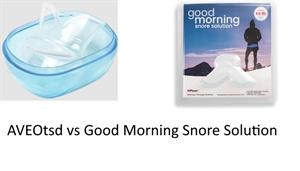
Both are tongue-stabilizing devices (TSDs): you squeeze a soft bulb, put the tip of your tongue inside and let go, and the suction holds your tongue forward so it can’t slide back and narrow your airway while you sleep. Neither one touches your teeth or moves your jaw, so both suit denture wearers and people with jaw pain. The differences are in the fit, the price, the return terms and the evidence behind each one.
How we tested: We bought and tested Good Morning Snore Solution ourselves (see our hands-on notes and video review below). We haven’t tested AVEOtsd; its details come from the maker’s specs, its FDA records and published research.
Check Good Morning Snore Solution price →
Links marked “Check price” are affiliate links; we may earn a commission at no extra cost to you. We have no affiliate link for AVEOtsd.
AVEOtsd vs GMSS: Side-by-Side Comparison
| Feature | AVEOtsd | Good Morning Snore Solution |
|---|---|---|
| Type | Suction tongue-stabilizing device | Suction tongue-stabilizing device |
| Maker | Innovative Health Technologies, Dunedin, New Zealand | MPowrx Health and Wellness Products (Canada) |
| Developed by | Dr. Chris Robertson, NZ dental sleep medicine specialist (sold since 1999) | Dr. Leslie Dort, Calgary dentist with a sleep-medicine background (sold since 2008) |
| Where it sits | Flanges rest on the outside of the upper and lower lips | Flange tucks between the lips and the front teeth |
| Material | Medical-grade silicone | Soft one-piece dental-grade plastic |
| Sizes | Small, Medium, Large (Medium fits over 90%, per the maker) | Regular and Small (young or smaller adult) |
| Price (official stores) | $99 Medium; $119 Small/Large; $159 Medium twin pack | $79.94 either size; two-pack $139.94 |
| Returns | 60 days for a single device, after contacting the maker; you ship it to New Zealand at your own cost | 30 days from delivery; device price refunded (shipping isn’t) |
| FDA status | 510(k) K231663 (2023), OTC aid to reduce snoring, adults 18+ | 510(k) K193239 (2020), OTC aid to reduce snoring, adults 18+ |
| Independent research | Yes: used in a randomized trial against a jaw splint (Deane 2009) | Limited: main trial led by its developer (Dort 2008) |
| Our pick for | People who want the most-studied device | Most US buyers; smaller mouths; easier returns |
Prices checked on both official stores in October 2026. They change often, so check before you buy.
What’s Actually Different Between Them
1. Where the device sits
This is the difference most comparison pages miss. In the clinical trial that used it, AVEOtsd users were told to place the device’s flanges on the outside of the upper and lower lips (Deane et al., 2009). The GMSS flange tucks behind the lips, against the front of the teeth and gums. If you have sensitive gums or front-tooth dental work, the AVEOtsd may feel less intrusive. If you find a flange pressing on your lips annoying, the GMSS may suit you better. Neither grips the teeth.
2. Sizing
AVEOtsd comes in three sizes, but the maker says the Medium fits over 90% of people and sells far more of it; Small and Large cost $119. GMSS has two sizes at the same price: Regular for most adults and Small for smaller mouths and young adults, plus a two-pack with one of each if you’re unsure. If you have a small mouth, GMSS is the easier choice (see best mouthpieces for small mouths).
3. Price and returns
GMSS is about $19 cheaper for a single device. The bigger difference is the return process:
- GMSS: 30 days from delivery. You email for a return authorization number, send the device back and get the device price refunded.
- AVEOtsd: the refund policy gives 60 days for a single device that didn’t work, but you must email the company first, try their advice, get an authorization and post the device to New Zealand at your own cost. With a twin pack, only one opened device is refundable. The product page also says opened, used devices aren’t refundable for a change of mind, so confirm the terms with the company before you buy. Defects are covered for 24 months.
AVEOtsd’s window is longer, but GMSS’s is simpler and cheaper to use from the US.
4. The evidence
Both devices rest on the same idea, and tongue-retaining devices as a category have reasonable evidence. A 2017 meta-analysis of 16 studies (242 patients) found they lowered the apnea-hypopnea index by an average of 53% in people with sleep apnea (Chang et al., 2017). For each product specifically:
- AVEOtsd: an independent randomized crossover trial in Sydney (27 people with sleep apnea, 22 completed) found it reduced breathing events about as much as a custom jaw splint, but compliance was poor: only 27% wore it every night for six hours or more, and 91% preferred the splint (Deane et al., 2009). A six-person pilot study co-authored by its inventor also found fewer loud snores (Kingshott et al., 2002).
- GMSS: the main trial is a randomized, controlled crossover study led by its developer, Dr. Leslie Dort, of a non-customized suction tongue device. With suction it reduced the snoring index from about 215 to 133 per hour, and 54% of participants said they would keep using it (Dort & Brant, 2008). Encouraging, but not independent.
Neither device is cleared to treat sleep apnea. Both FDA clearances cover snoring in adults only.
5. Material and feel
AVEOtsd is injection-molded medical-grade silicone. GMSS is a soft, one-piece dental-grade plastic. Both are flexible; buyers commonly describe both as odd-feeling for the first week or two, with a sore tongue tip and extra saliva, before they get used to them.
AVEOtsd: Strengths and Weaknesses

- Good: the most independently studied over-the-counter TSD; medical-grade silicone; nothing behind the lips; three sizes; 24-month defect warranty.
- Not so good: $99 for the common size; returns go to New Zealand at your expense; often comes off during sleep (86% of trial participants reported involuntary removal).
Full details are in our AVEOtsd review.
Good Morning Snore Solution: Strengths and Weaknesses

- Good: $79.94 in either size; a true Small size; simple 30-day money-back guarantee; FDA-cleared since 2008 (latest clearance 2020).
- Not so good: flange sits against the gums; less independent research; can slip off for stomach sleepers; you need a clear nose.
Full details are in our Good Morning Snore Solution review.
Check Good Morning Snore Solution price →
Who Should Use Either Device, and Who Shouldn’t
A suction tongue device of either brand is a good match if you:
- Wear dentures or have few natural teeth (see best mouthpieces for denture wearers).
- Have crowns, bridges or implants you don’t want a tray pulling on.
- Got jaw pain from a jaw-advancing mouthpiece, or have TMJ problems.
- Breathe comfortably through your nose with your mouth closed.
Skip both, or talk to a doctor or dentist first, if you:
- Have a blocked nose most nights, a deviated septum or bad allergies. You can’t breathe through your mouth with either device in.
- Might have sleep apnea. Loud snoring with pauses in breathing, gasping or heavy daytime sleepiness needs a sleep test first. See can snoring mouthpieces treat sleep apnea?
- Are under 18, have central sleep apnea, or have sores on your tongue.
If You Have Healthy Teeth, Consider a Jaw Device Too

Tongue devices exist mainly for people who can’t wear a mandibular advancement device. If your teeth and jaw are healthy, the research above suggests most people find a jaw device easier to keep wearing. Our top-rated option is SnoreRx Plus ($99.99, 30-night guarantee), an adjustable boil-and-bite device with a hinge so your mouth isn’t locked shut. It also leaves room to breathe through your mouth, which neither tongue device does. See SnoreRx Plus vs GMSS or TSD vs MAD.
Our Hands-On Test: Good Morning Snore Solution
We bought Good Morning Snore Solution and tested it ourselves. The box held the device, directions for use, a packet of cleaning solution and a storage case. You place the flange between your lips and front teeth, squeeze the bulb, put the tip of your tongue in and let go. Over three nights our tester snored less, though some snoring remained, and an overnight oxygen recording showed adequate oxygen levels. It fell out a few times during the night, and because it sticks out of the mouth, our tester had to sleep on their back to keep it in. You need to breathe well through your nose, and the booklet warns it can take up to six weeks to get used to it.
Full details, photos and screenshots are in our Good Morning Snore Solution review.
What our testing adds to this comparison: Our test showed the typical tongue-device trade-off: GMSS reduced our tester’s snoring, but it slipped out a few times a night and our tester had to sleep on their back to keep it in. If you sleep on your side or stomach, factor that in whichever tongue device you choose. We can’t say from our own use whether AVEOtsd stays in better.
One tester’s nights are a real-world example, not a clinical trial. Snoring varies from person to person and night to night, and a snoring app or fingertip oxygen recording is not a sleep test.
Verdict: AVEOtsd or GMSS?
- Choose Good Morning Snore Solution if you’re in the US, want the lower price, have a smaller mouth, or want a return process that doesn’t involve international shipping. It is our top-rated tongue device.
- Choose AVEOtsd if you specifically want the device with the stronger independent research, prefer silicone, or find a flange behind your lips uncomfortable.
- Choose neither if you breathe through your mouth at night; a jaw device with a breathing gap is a better fit.
Related Comparisons
- SnoreRx vs AVEOtsd
- SnoreRx Plus vs AVEOtsd
- Zyppah vs Good Morning Snore Solution
- VitalSleep vs Good Morning Snore Solution
- Best tongue stabilizing devices
Frequently Asked Questions
AVEOtsd vs GMSS: which is better?
For most US buyers, GMSS: it’s about $19 cheaper, has a Small size and a simple 30-day money-back guarantee. AVEOtsd has more independent research and sits outside the lips, but returns mean shipping to New Zealand.
Do AVEOtsd and Good Morning Snore Solution work the same way?
Yes. Both use suction on the tip of the tongue to hold it forward so it can’t fall back toward the throat. The main design difference is that AVEOtsd’s flanges rest outside the lips, while the GMSS flange sits between the lips and front teeth.
Are both FDA-cleared?
Yes. AVEOtsd was cleared in 2023 (K231663) and GMSS most recently in 2020 (K193239), both for over-the-counter use as an aid to reduce snoring in adults 18 and older. Neither is cleared to treat sleep apnea.
Can I use either with dentures?
Yes. Neither device grips the teeth, which is why tongue devices are the usual suggestion for denture wearers. Ask your dentist whether to keep your dentures in at night.
Why does my tongue hurt with a tongue device?
Too much suction is the usual cause. Squeeze the bulb less before inserting, and build up wear time over a week or two. Stop and see a doctor or dentist if your tongue becomes cut, ulcerated or numb.
Which is easier to return?
GMSS, for US buyers: 30 days from delivery, with the device price refunded. AVEOtsd allows 60 days for one used device, but you have to ship it to New Zealand at your own cost.