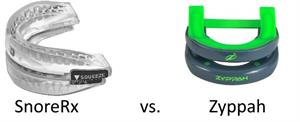
SnoreRx is the better choice for most snorers, and it costs about $40 less. SnoreRx ($59.99) is a boil-and-bite jaw device you can move forward in numbered 1 mm steps. Zyppah ($99.95) gives a slight, fixed jaw position plus an elastic band over the tongue. Zyppah’s real advantages are that tongue band and a 91-day money-back guarantee, three times longer than SnoreRx’s 30 nights.
How we tested: We bought and tested SnoreRx ourselves (see our hands-on notes and video review below). We haven’t tested Zyppah; its details come from the maker’s specs and its FDA records.
This page focuses on what the extra $40 buys you and how far to trust the effectiveness claims. If you are weighing Zyppah against the hinged, $99.99 SnoreRx Plus instead, read SnoreRx Plus vs Zyppah.
Bottom line: SnoreRx takes it overall (8.8 vs 7.6), leading most on comfort and best suited for calibrated micro-adjustment. Choose Zyppah if jaw + tongue combo is your priority.
Links marked “Check price” are affiliate links; we may earn a commission at no extra cost to you.
Quick Verdict
- Buy SnoreRx if you want the most adjustment for the least money. Start at 1 mm, move up slowly, and stop at the first setting that controls your snoring.
- Buy Zyppah if you want a tongue band as well as jaw support and would rather have a 91-day trial than an adjustable device.
- Talk to a doctor first if your snoring comes with gasping, pauses in breathing or heavy daytime sleepiness. Neither device is a sleep apnea treatment.
- Our hands-on test: SnoreRx fitted well and clearly reduced our tester’s snoring over three nights. We haven’t tested Zyppah.
SnoreRx vs Zyppah at a Glance
| Feature | SnoreRx | Zyppah |
|---|---|---|
| Design | Two-tray MAD, no hinge | One-piece tray + elastic tongue band |
| Price (single) | $59.99 | $99.95 |
| Two-pack | $99.99 | $190.00 |
| Guarantee | 30 nights (snorerx.com purchases) | 91 days (direct purchases) |
| Jaw adjustment | 1 mm steps from a 1 mm factory setting | None; slight fixed advancement |
| Tongue support | Indirect (moving the jaw brings the tongue forward) | Direct band over the tongue, plus slight jaw advancement |
| FDA 510(k) | K153200 and K170825 (snoring, adults 18+) | K182312 (snoring, adults 18+) |
| Maker | Apnea Sciences, Aliso Viejo, California | Zyppah, designed by Dr. Jonathan Greenburg |
| Replacement | No official lifespan; independent reviewers cite about 12–18 months | Every 4–6 months, per the maker |
| Our scores (overall / effectiveness / comfort) | 8.8 / 9.0 / 8.5 | 7.6 / 8.0 / 7.2 |
Prices from snorerx.com and zyppah.com, October 2026. Check the merchant for current offers.
What the Extra $40 Gets You With Zyppah
Because SnoreRx is cheaper and more adjustable, the fair question is what Zyppah offers in return. There are three things:
- A tongue band. A stretchy band across the back of the tray rests on the tongue to discourage it from sliding back. SnoreRx has no equivalent part; like every mandibular advancement device, it moves the tongue only indirectly, because the tongue is attached to the lower jaw.
- A longer trial. 91 days against 30 nights. That is a real benefit, because the first week with any mouthpiece is often uncomfortable and tells you little about long-term results.
- A gentler starting position. Zyppah’s advancement is slight. SnoreRx can match that by staying at its lower settings, so this is less of a difference than it first appears.
Against that, you give up the numbered adjustment and you take on a shorter replacement cycle. Zyppah’s maker recommends a new device every 4–6 months. Over a year, that typically means buying two or three Zyppahs (about $200–$300 at the single price) versus one or two SnoreRx units. The SnoreRx two-pack at $99.99 costs about the same as one Zyppah.
Do They Work? Looking at the Claims
FDA clearance: what it does and doesn’t mean
Both devices went through the FDA’s 510(k) process and are cleared as aids to reduce snoring in adults 18 and over. A 510(k) clearance means the FDA judged the device substantially equivalent to devices already on the market. It is the normal route for snoring mouthpieces, but it is not “FDA approval,” and it is not proof of a particular success rate. According to Zyppah’s published 510(k) summary, its over-the-counter clearance rested on bench and biocompatibility testing rather than a clinical trial. Neither clearance covers sleep apnea.
Zyppah’s “91% of users” claim
Zyppah’s website says it is “clinically proven to stop snoring in 91% of users” and points to a study now published in the Journal of Sleep Disorders and Management. Before relying on that number, it helps to know how the study worked:
- People who self-reported snoring were mailed an investigational device and filled in questionnaires before and after 10 days of use. 570 completed the study.
- The 91% figure is the share who reported some benefit, not the share whose snoring stopped as measured in a sleep lab.
- The published abstract does not describe a control or placebo group.
- Dr. Greenburg, Zyppah’s designer, is one of the authors, so it is not an independent study.
- The abstract describes a device that “does not reposition the mandible,” while the Zyppah sold today also moves the jaw slightly forward. It is not clear that the study device and the current product are identical.
None of this means Zyppah doesn’t work. It means the 91% figure is a short-term, self-reported result from a company-linked study, and you should treat it as marketing rather than a reliable success rate.
SnoreRx
SnoreRx does not advertise a success percentage. Its case rests on the general evidence for jaw-advancing oral appliances in snoring and on the ability to find your own effective setting. Buyers commonly report a drop in snoring within the first week or two, usually after moving up a couple of settings, while negative reviews mostly involve bulk, jaw soreness or a poor impression. Our SnoreRx complaints guide covers those in detail.
Fitting and Day-to-Day Use
SnoreRx is fitted with water boiled in a microwave mug (the maker warns against a stovetop pan): 60 seconds in the water, a 1–2 second cool dip, a 30-second bite, then 5 minutes in cool water. You get two attempts. To adjust it, squeeze the two marked spots on the upper tray and slide the lower tray to the next number. The booklet suggests at least three to five nights per setting; most people end up between 3 and 5 mm.
Zyppah is softened for about 40 seconds in water just off the boil, lifted out by the band, and bitten into for about 60 seconds. If it falls out at night, Zyppah’s advice is to re-mold it more firmly. There is no setting to change afterward.
Both are covered in our fitting guide.
Comfort: Closed Tray vs Tongue Band
Neither device is the comfort champion. SnoreRx is a rigid two-tray design with no hinge, so your mouth stays closed in one position; some people find their lips don’t close comfortably around it. Zyppah’s weak point is the band: buyers commonly report either getting used to it within a few nights or finding it gag-inducing and giving up. Expect the normal first-week effects with both, such as extra saliva and a tender jaw or teeth in the morning.
If you like SnoreRx’s adjustment but worry about the locked-shut feel, the hinged SnoreRx Plus solves that for $99.99, the same money as a Zyppah.
Cleaning and Care
- SnoreRx: brush gently with a toothbrush and toothpaste after each use, air-dry, and store in the case. Avoid ammonia, bleach, alcohol-based mouthwash and denture-tablet soaks.
- Zyppah: rinse with cool water each morning (or use the maker’s Z Clean). Don’t soak it or use warm or hot water, which can affect the fit. Toothpaste can leave residue in the impressions, so rinse well if you brush it.
More in how to clean a snoring mouthpiece.
Which Should You Buy?
SnoreRx is the stronger value: it is cheaper, it adjusts in small repeatable steps, and it usually lasts longer before replacement.
Zyppah is worth the premium if the tongue band and the 91-day trial matter more to you than adjustment.
Our Hands-On Test: SnoreRx
We bought SnoreRx and tested it ourselves. The box held the mouthpiece, a storage case and an instruction booklet. The parts that touch your teeth are a soft, moldable lining over a firm frame, and after fitting we had deep, clear tooth impressions. You adjust it by pressing the sides and pulling the lower tray forward a step at a time. The front airway opening is about 3 mm: enough to breathe through, but too small to push your tongue through. Our tester recorded their snoring before using it, then wore SnoreRx for three nights, and the snoring-app recordings showed a significant drop in snoring each night. An overnight oxygen recording made while wearing it stayed above the report’s warning line. We found it comfortable as well as effective.
Full details, photos and screenshots are in our SnoreRx review.
What our testing adds to this comparison: SnoreRx is the one we have used: a clean fit and a clear drop in snoring over three nights. Our Zyppah notes come from the maker and the FDA, not our own nights.
One tester’s nights are a real-world example, not a clinical trial. Snoring varies from person to person and night to night, and a snoring app or fingertip oxygen recording is not a sleep test.
Who Should Avoid Both
Skip both, or get a dentist’s or doctor’s advice first, if you are under 18; wear dentures or braces; have loose teeth, gum disease or a history of TMJ problems; have central sleep apnea or a respiratory disorder; or have crowns, caps or implants your dentist hasn’t cleared. Loud snoring can be a sign of obstructive sleep apnea, so get a sleep test if you have warning signs. The full checklist is in who should not use a snoring mouthpiece.
Frequently Asked Questions
Is SnoreRx or Zyppah better?
SnoreRx, for most people. It scores 8.8 overall against 7.6 for Zyppah in our ratings, costs about $40 less, and can be adjusted after fitting. Zyppah is the better pick only if you specifically want its tongue band or a 91-day trial.
Is Zyppah’s 91% success rate real?
It comes from a study of 570 people who reported their own results after 10 days, with no control group described in the abstract and the device’s designer among the authors. It shows many users felt it helped, not that it stops snoring in 91% of people.
Are both FDA approved?
Both are FDA cleared through the 510(k) process (SnoreRx K153200; Zyppah K182312) as aids to reduce snoring in adults. Clearance is not the same as approval, and neither covers sleep apnea.
Which is cheaper to own for a year?
Usually SnoreRx. Zyppah’s maker recommends replacement every 4–6 months at $99.95 each; SnoreRx costs $59.99, or $99.99 for two, and independent reviewers commonly report it lasting about a year or more.
Is Zyppah still sold?
Yes. As of October 2026 it was on sale at zyppah.com for $99.95 with a 91-day money-back guarantee.
Related Comparisons
- SnoreRx Plus vs Zyppah
- Zyppah vs ZQuiet
- VitalSleep vs Zyppah
- ZQuiet vs SnoreRx
- SnoreRx vs VitalSleep
- PureSleep vs SnoreRx