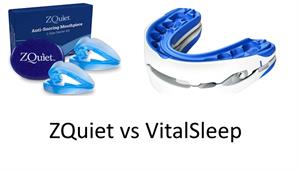
ZQuiet and SnoreRx cost almost the same (about $60), but they take opposite approaches. ZQuiet is a soft, ready-to-wear mouthpiece with a flexible hinge and two fixed sizes, so you can use it the first night with no boiling. SnoreRx is a firmer boil-and-bite device that you mold to your teeth and then adjust in 1 mm steps. Pick ZQuiet if comfort and zero setup matter most; pick SnoreRx if you want a molded fit and precise control over how far your jaw moves forward.
How we tested: We bought and tested both ZQuiet and SnoreRx ourselves; our hands-on notes and video reviews are below.
On our scorecards SnoreRx rates 8.8 out of 10 and ZQuiet 8.5. ZQuiet scores higher for comfort and ease of use; SnoreRx scores higher for effectiveness, because you can fine-tune it.
ZQuiet vs SnoreRx: Side-by-Side
| Feature | ZQuiet | SnoreRx |
|---|---|---|
| Type | Ready-to-wear MAD with flexible “living hinge” | Boil-and-bite MAD with calibrated adjustment |
| Price (maker) | $59.95 (2-Size Starter Pack) | $59.99 (2 for $99.99) |
| Guarantee | 60-night Better Sleep Guarantee | 30-night money-back (snorerx.com only) |
| Fitting | None — wear it out of the box; edges can be trimmed | Boil-and-bite: 60 s in boiled water, 30 s bite, 5 min to set |
| Jaw advancement | Two fixed sizes: about 2 mm (Size 1) and 6 mm (Size 2) | 1 mm steps from 1 to 6 mm |
| Mouth movement | Mouth can open; jaw can shift slightly side to side | Trays lock together; mouth held in one position |
| Feel | Thin, soft, flexible | Firmer, bulkier, molded to your teeth |
| Maker’s replacement guidance | Every 4–6 months | Typically lasts 6–11 months |
| FDA | 510(k) cleared, OTC, snoring in adults 18+ (K180124) | 510(k) cleared, OTC, snoring in adults 18+ (K170825) |
| Where sold | zquiet.com and an official Amazon store | snorerx.com (guarantee applies only there) |
| Our score | 8.5 / 10 (comfort 9.2, ease of use 9.0) | 8.8 / 10 (effectiveness 9.0) |
| Best for | First-timers, light to moderate snorers, people who hate bulky trays | Nightly snorers who want to dial in the smallest setting that works |
Prices checked on the makers’ sites in October 2026; offers change.
Quick Verdict
- Choose ZQuiet if you want to start tonight, you have found other mouthguards too bulky, you sometimes breathe through your mouth, or you want the longer 60-night guarantee.
- Choose SnoreRx if you snore most nights, you want the device molded to your teeth so it stays put, or you suspect you need an in-between amount of advancement.
- Choose neither if you wear dentures, have loose teeth, gum disease or TMJ problems, or your snoring comes with pauses in breathing or gasping. See who should skip both.
- Our hands-on tests: both reduced our tester’s snoring, but ZQuiet left them with sore bottom front teeth each morning, while SnoreRx was comfortable.
How Each One Works
Both are mandibular advancement devices. They hold the lower jaw slightly forward, which brings the base of the tongue forward and widens the airway so the soft tissue at the back of the throat vibrates less. The FDA treats them as the same kind of device: ZQuiet’s own 2018 clearance filing compared it directly with SnoreRx. The differences are in how they grip your teeth and set the jaw position.

ZQuiet: flexible hinge, two fixed sizes
ZQuiet is two thin trays joined at the back by a flexible strip of the same material, the “living hinge.” That strip sets how far forward the lower jaw sits, but it lets your mouth open and close and allows some side-to-side movement. The 2-Size Starter Pack contains Size 1 (about 2 mm of advancement) and Size 2 (about 6 mm). You start with Size 1 and move to Size 2 only if you are still snoring once your jaw has adapted.
SnoreRx: molded trays, 1 mm steps

Shown: SnoreRx Plus. The original SnoreRx uses the same molded trays and adjuster, without the hinge.
SnoreRx is two rigid trays lined with boil-and-bite material that you mold to your teeth. To adjust it, you squeeze the two marked spots, slide the lower tray to the next number, and release. It ships at 1 mm; the maker says to wear each setting for three to five nights before advancing, that most people settle between 3 and 5 mm, and that it goes up to 6 mm.
Adjustment: The Biggest Practical Difference
Interestingly, both devices top out at roughly the same advancement, about 6 mm. What differs is everything in between.
With ZQuiet, there is a 2 mm setting and a 6 mm setting and nothing in the middle. If Size 1 doesn’t stop your snoring and Size 2 makes your jaw ache, ZQuiet has no answer, and that is the most common reason people move on to an adjustable device.
With SnoreRx you can stop at 3, 4 or 5 mm. The right amount of advancement is the smallest one that controls your snoring, because every extra millimeter adds strain on the jaw joint. Being able to find that point is why SnoreRx scores higher for effectiveness. Our guide on how to adjust a snoring mouthpiece explains the process.
If you like ZQuiet’s approach but want more steps, ZQuiet also sells the ZQuiet Advance ($89.95), a separate moldable design that uses interchangeable straps for different advancement settings.
Winner for adjustment: SnoreRx.
Comfort and Fit
ZQuiet is the more comfortable device for many people, especially at first. It is thin and soft, and the hinge means you don’t feel locked shut. You can sip water or say a few words without taking it out. That matters: a mouthpiece that ends up on the nightstand stops nobody’s snoring.
SnoreRx feels bulkier. It is a rigid two-tray design, some users can’t close their lips comfortably around it, and it holds your mouth in one position. Its advantage is grip: because it is molded to your teeth, it is less likely to work loose overnight than a universal tray.
ZQuiet’s fit depends on your teeth. The maker says it works best with fairly straight front teeth; crowded or uneven teeth can make the universal trays sit poorly or fall out. If ZQuiet feels long or rubs, the edges can be trimmed without voiding the guarantee.
Both cause the usual MAD side effects while you adapt: morning jaw and tooth tenderness, extra saliva or dry mouth. These usually settle within a week or two. Persistent pain, or a bite that doesn’t return to normal soon after you take the device out, means stop and see a dentist. See jaw pain from a snoring mouthpiece and the most comfortable snoring mouthpieces.
Winner for comfort: ZQuiet.
Mouth Breathers
If you breathe through your mouth at night, ZQuiet’s hinge lets your mouth open, which many mouth breathers find easier. SnoreRx has an open front for airflow, but your mouth stays in one position. Mouth breathing is often a sign of nasal congestion, which no jaw device fixes on its own; see the best mouthpiece for mouth breathers.
Price, Guarantee and Yearly Cost
The sticker prices are four cents apart: ZQuiet’s 2-Size Starter Pack is $59.95 and SnoreRx is $59.99. The guarantees differ more:
- ZQuiet: 60-night Better Sleep Guarantee; shipping fees are not refunded.
- SnoreRx: 30-night money-back guarantee for new customers buying at snorerx.com; refunds cover the product price, not shipping.
Replacement changes the math. ZQuiet recommends replacing the mouthpiece every 4–6 months with nightly use. SnoreRx’s FAQ says SnoreRx typically lasts 6–11 months. Both wear faster if you grind or clench. A rough first-year estimate, before shipping and any discounts:
- ZQuiet: starter pack ($59.95) plus one or two single-size replacements at $39.95 each: about $100–$140.
- SnoreRx: one or two devices: about $60–$120, or the two-pack for $99.99.
In other words, the yearly cost is similar. ZQuiet also offers subscription refills, which can lower its ongoing cost. See how long snoring mouthpieces last.
Value: roughly a tie. ZQuiet’s longer guarantee makes it the lower-risk first try; SnoreRx lasts longer between replacements.
Who Should Buy ZQuiet
- First-time mouthpiece users who want to find out whether jaw advancement helps them.
- Light to moderate snorers.
- People who found other mouthguards bulky or claustrophobic.
- Anyone who wants no boiling or molding, or a longer 60-night trial.
Read the full ZQuiet review for sizes, trimming and common complaints.
Who Should Buy SnoreRx
- Nightly, loud snorers who expect to wear a device long term.
- People who tried ZQuiet and found Size 1 not enough and Size 2 too much.
- People whose teeth don’t hold a universal tray well.
Read the full SnoreRx review. If you like SnoreRx’s adjustment but want a hinge too, see SnoreRx Plus vs ZQuiet and SnoreRx vs SnoreRx Plus.
Our Hands-On Tests
We bought and tested both of these mouthpieces ourselves and filmed each test for our YouTube channel.
ZQuiet
We bought ZQuiet and tested it ourselves. The box held a case with two mouthpieces in different sizes, plus three booklets: instructions for use and care, sleep tips, and a booklet for couples. There is nothing to boil; the soft, flexible trays are ready to wear. Fully closed, the front opening is about 3 mm, though the hinge usually keeps the mouth open a little wider. Over a few nights, snoring-app recordings showed quieter snoring while wearing it. It was easy to use, but our tester woke every morning with soreness between the bottom front teeth and lip, with both sizes. We put that down to the trays not being molded to the teeth.
Full details, photos and screenshots are in our ZQuiet review.
SnoreRx
We bought SnoreRx and tested it ourselves. The box held the mouthpiece, a storage case and an instruction booklet. The parts that touch your teeth are a soft, moldable lining over a firm frame, and after fitting we had deep, clear tooth impressions. You adjust it by pressing the sides and pulling the lower tray forward a step at a time. The front airway opening is about 3 mm: enough to breathe through, but too small to push your tongue through. Our tester recorded their snoring before using it, then wore SnoreRx for three nights, and the snoring-app recordings showed a significant drop in snoring each night. An overnight oxygen recording made while wearing it stayed above the report’s warning line. We found it comfortable as well as effective.
Full details, photos and screenshots are in our SnoreRx review.
What our testing adds to this comparison: In our tests, both reduced snoring. The difference was comfort: ZQuiet, which isn’t molded to your teeth, caused morning soreness at the bottom front teeth with both sizes, while the molded SnoreRx was comfortable. That reverses the usual assumption that the ready-to-wear device is the comfortable one, at least for our tester.
One tester’s nights are a real-world example, not a clinical trial. Snoring varies from person to person and night to night, and a snoring app or fingertip oxygen recording is not a sleep test.
Who Should Skip Both
- People with full dentures. Both devices need natural teeth to hold on to; a tongue-stabilizing device such as Good Morning Snore Solution is the usual alternative.
- People with loose teeth, active gum disease, recent dental work or braces, or a history of TMJ disorder.
- Anyone under 18.
- Anyone with signs of sleep apnea: pauses in breathing, choking or gasping at night, morning headaches or heavy daytime sleepiness. Both devices are cleared only to reduce snoring. Snoring can be a sign of obstructive sleep apnea, so see a doctor for a sleep test before self-treating. Read can snoring mouthpieces treat sleep apnea?
More in who should not use a snoring mouthpiece.
Related Comparisons
- SnoreRx Plus vs ZQuiet
- SnoreRx vs SnoreRx Plus
- ZQuiet vs VitalSleep
- ZQuiet vs PureSleep
- Good Morning Snore Solution vs ZQuiet
- PureSleep vs SnoreRx
The Bottom Line
ZQuiet is the easier, softer mouthpiece and the lower-risk first try, thanks to its 60-night guarantee and no fitting step. SnoreRx is the more precise one: it molds to your teeth and lets you stop at exactly the setting that works, which is why it scores higher overall. If you already know you snore loudly every night, start with SnoreRx. If you are not sure a mouthpiece is for you at all, start with ZQuiet.
Frequently Asked Questions
Is ZQuiet or SnoreRx better?
SnoreRx is better for precise control, and it scores 8.8 overall against ZQuiet’s 8.5 in our ratings. ZQuiet is better for comfort and convenience. If you snore heavily every night, SnoreRx is usually the better fit; if you want something soft that works out of the box, choose ZQuiet.
What is the difference between ZQuiet and SnoreRx?
ZQuiet is ready to wear, soft and hinged, with two fixed advancement sizes (about 2 mm and 6 mm). SnoreRx is boil-and-bite, molded to your teeth, and adjusts in 1 mm steps up to 6 mm. ZQuiet has a 60-night guarantee; SnoreRx has 30 nights.
Do you need to boil ZQuiet like SnoreRx?
No. ZQuiet needs no boiling or molding. SnoreRx is molded once in boiled water and can be re-molded one more time if the first impression is shallow.
Which is more comfortable, ZQuiet or SnoreRx?
For most people, ZQuiet. It is thinner and softer, and the living hinge lets your mouth open. SnoreRx is bulkier but grips the teeth better because it is molded to them.
Which lasts longer?
SnoreRx, according to the makers’ own guidance: ZQuiet recommends replacement every 4–6 months, while SnoreRx says its device typically lasts 6–11 months. Teeth grinding shortens both.
Can ZQuiet or SnoreRx treat sleep apnea?
No. Both are FDA-cleared only to reduce snoring in adults. If you have or suspect sleep apnea, see a doctor first.
Thinking of switching? See ZQuiet alternatives matched to the most common ZQuiet complaints.